
Lenten Reflection (Ash Wednesday)
 As we have sprung into the season of Lent on this Ash Wednesday it begins on a different note for me. Usually this is the first day of my fast from my usual luxuries and indulgences, such as fast food, Starbucks, ice cream, soda, and various other fun food items. This “sacrifice” is meant to draw me nearer to God and carve out a space in which to turn my whole self over to the Almighty. However, much of the time this act of giving up my indulgences turns into an act of false piety. I have probably unconsciously decided that I wanted to give those things up to be healthier during the season of Lent, and less about my relationship with God. In fact, I remember a time in college when I was probably close to 300 pounds and I decided that during Holy Week I would fast from all food. Certainly this began with the best intentions, as the fast got hard, my mind was not disciplined to turn to God in prayer, but rather I turned to consuming the “permitted” juices I allowed myself. That fast, just like many I have begun during Lent, became more about the act of fasting than the fact that I need to be clearing out space in my life for God.
While I have seen many Facebook posts and tweets about the various items my circle of friends are giving up for Lent, I thought long and hard about giving up something for Lent. I knew I wasn’t going to do the usual suspects, because that has become the routine that I wish not to repeat, and besides in the past year many of those things do not have the same grip that they once did. If I were to give up food, I would need to replace that food with something nourishing my body. That led me to the biggest drain on my time, television. It has a weird hold on me, not that I just sit in front of the television and zone out, it is mainly on as background noise, but it diminishes the quality time spent with my loved ones and God. Tonight was the first night that we didn’t turn the television on, and instead I danced with my daughter, had a conversation with my wife, read my Bible, and blogged here. By cutting that one beam of distraction out space was carved out for God to move.
God has not called me to give up television. Sacrifice for the sake of sacrifice is empty, and it is a luxury that I am “sacrificing”, and it is vital that I understand that God HAS called me to give my whole heart, my whole mind, my whole strength, and my whole self to worship. Let’s remember that, in this season of Lent and beyond.
Five Ways to An Extraordinary Life
Here is a video from RELEVANT Magazine that is from Bob Goff’s Steps to Living Extraordinary Lives.
Advent, The Beginning…
Here we are again, the beginning of the liturgical year. Have you pulled out your purple? Advent’s liturgical color is purple and we began it this Sunday. Most of what we celebrate as, “The Holidays” are during this time in the Christian calendar, however this time of year is when we usher in the coming of the Christ child, and prepare our hearts, minds, and souls for the second coming of Christ. In churches across the world people began lighting their wreaths, and they began by lighting the candle of peace.
The church I attended this morning used the following passages…
Isaiah 2:1-5 ESV
The word that Isaiah the son of Amoz saw concerning Judah and Jerusalem. It shall come to pass in the latter days that the mountain of the house of the Lord shall be established as the highest of the mountains, and shall be lifted up above the hills; and all the nations shall flow to it, and many peoples shall come, and say: “Come, let us go up to the mountain of the Lord , to the house of the God of Jacob, that he may teach us his ways and that we may walk in his paths.” For out of Zion shall go the law, and the word of the Lord from Jerusalem. He shall judge between the nations, and shall decide disputes for many peoples; and they shall beat their swords into plowshares, and their spears into pruning hooks; nation shall not lift up sword against nation, neither shall they learn war anymore. O house of Jacob, come, let us walk in the light of the Lord .
Matthew 24:36-44 ESV
“But concerning that day and hour no one knows, not even the angels of heaven, nor the Son, but the Father only. For as were the days of Noah, so will be the coming of the Son of Man. For as in those days before the flood they were eating and drinking, marrying and giving in marriage, until the day when Noah entered the ark, and they were unaware until the flood came and swept them all away, so will be the coming of the Son of Man. Then two men will be in the field; one will be taken and one left. Two women will be grinding at the mill; one will be taken and one left. Therefore, stay awake, for you do not know on what day your Lord is coming. But know this, that if the master of the house had known in what part of the night the thief was coming, he would have stayed awake and would not have let his house be broken into. Therefore you also must be ready, for the Son of Man is coming at an hour you do not expect.
We have this for which to look forward, Christ is coming back. Although we do not know the amount of time that will pass before Christ returns, we can be assured that Christ IS returning. That is the what we use Advent to celebrate and prepare for the return. When we look in the Matthew passage, we are told that the time of the coming of Christ will be like the rest of our days, there will not be any special warning, no tornado alarms, no early warning signals, not even NSA surveillance will be able to alert us to the coming of Christ. Therefore, we need to make ourselves ready, prepare ourselves for the day that Christ returns. We could call this “Christ-coming Preppers” instead of “Doomsday Preppers”. We need to prepare our hearts and minds for Christ, giving ourselves wholly over to holiness.
However, this time will also usher in a period of peace. God will bring peace on Earth. No longer will disputes between nations lead to war, but rather we will work toward producing instead of destroying. This is also part of preparing ourselves for the coming of Christ. Instead of a constant arguing or fighting with our fellow human over our differences, we need to work on finding common ground and a way to discuss our issues in peace. Working on our hearts to finding and cultivating peace in our daily interactions is something we use our lives for during this season of Advent.
So during this season, as we seek to prepare our hearts for Christ’s return, let us seek toward making peace flow from and through us by the power of the Holy Spirit.

Maybe I should start with seeking peace with my daughter as her Advent was ushered in with tears and chants for, “mama”.
3:46:00
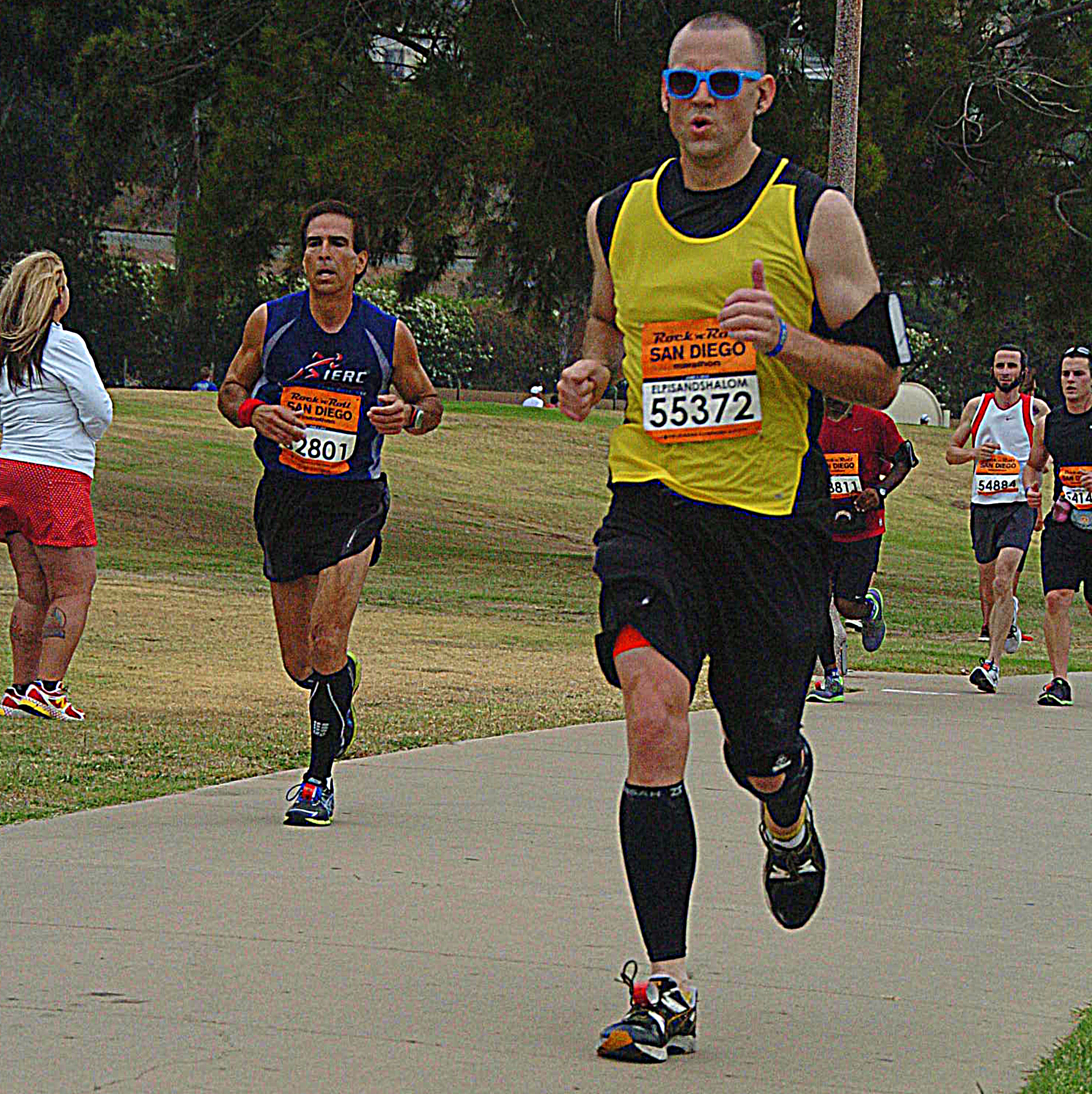
This past summer I ran my fastest marathon in three hours, forty-six minutes, and no seconds. Although this time is not terribly fast by the standards of marathon running, although it was much faster than I could imagine I could run a marathon even a year ago. In Jr. High and in High School I was an athlete, but when in college, I realized I didn’t want to pursue athletics any longer, for many reasons that are not important, I quickly lost the athlete within. I covered him up with sloth, with gluttony, with self-destructive habits, and just letting myself go.
In early 2009, I realized that these habits were going to lead to my ultimate demise. I wasn’t going to be around when my son was going to grow up, I wasn’t going to be able to participate and play with him as he got older. At nearly 350 lbs I was on track toward a shortened life span, and maybe not seeing my son grow up. I decided to begin an exercise regiment. This wasn’t huge, I walked slowly on a treadmill for an hour three times a week, and I jumped in a pool and swam once a week. I also learned portion control, one breakfast, one lunch, and one dinner, no more “Taco Bell Fourth Meal”. In the midst of this first step, I began losing weight, within six months 50 pounds, and 80 lbs were off by Christmas 2009. There was no magic diet, I ate less, and I exercised more.
Have you noticed the pattern? Have you realized my error? I, I, I, I, I, and I. I am taking the credit for all this hard work. Certainly, I did the work, but it was through the power of the Holy Spirit that I was prompted, I merely answered the call. Through the power of the Holy Spirit, I was transformed, not only spiritually, but also emotionally and physically. I was broken, and I needed fixing. God took hold of me, and shook me.
This shook me straight into a crazy thought, I should run a marathon! I set my sights on the next LA Marathon. My sister encouraged me to run at least a half-marathon before that, so we ran in the Las Vegas Half in December 2010. I completed that race in just over two hours, and was able to set a goal for the marathon of five hours. I had lost nearly 100 pounds, and felt as if I was ready to take on 26.2 miles. That was 2011, and a legendary rain filled LA Marathon struck. Shortly into the race, my focus shifted from my goal of five hours to finishing the race. Every joint hurt, my legs were tight, and I started counting down the miles or fractions thereof. All the hard work led to pain, and I was barely able to keep my legs going. After 5 hours and 17 minutes, I crossed the finish line, bruised, battered, and barely walking. (As a thank you, the LA Marathon team gave us the opportunity to walk an additional mile so that we could get our gear.)
I accomplished something, I finished the ridiculous distance, and I was not beaten by the weather. I was proud that I accomplished a feat that only a small percentage of people have accomplished, but my feat was not impressive. I was still far from what I could be, and far from what I was before the stench of sloth covered over body. I kept running more and more and my next race was a two hour half marathon later in the year. After that race my daughter was born and the training took a brief hiatus, but when I restarted I set my sights on another marathon, this one the 2012 Santa Clarita Marathon. I followed a strict training regiment and figured I would improve upon the five hour marathon and set my goal to run it in four and a half hours. However, half way into the race I realized that I was in much better shape and was most likely going to beat the goal I set for myself, and I was on pace to run a four hour marathon. I eventually finished the race in just over four hours as I slowed down at mile 24, but this was a huge win for my psyche.
First I worked hard to lose weight, then I worked hard to get myself into better shape, however it was all worthless compared to the riches I have in Christ. However, the way that I have worked on losing weight, and running faster only serve to show that I am constantly being refined and made better by the work of the Holy Spirit moving in my life. So I sit here tonight, having accomplished running a marathon in three hours and forty-six minutes, and having lost more than 150 pounds, but God is still working on me. Not to lose more weight, and maybe not to even run any faster, but God is working to refine me, and make me more into the man that God desires, a man after God’s own heart.
Paul reminds us in his letter to the church in Philippi, “Not that I have already obtained this or am already perfect, but I press on to make it my own, because Christ Jesus has made me his own. Brothers, I do not consider that I have made it my own. But one thing I do: forgetting what lies behind and straining forward to what lies ahead, I press on toward the goal for the prize of the upward call of God in Christ Jesus.” (Philippians 3:12-14 ESV)
God isn’t finished with us. I have a marker and a path I have followed, and although I took the steps toward where I am today, God is the one that worked on me, and has brought me on this path toward holiness and sanctification. I pray that as I continue in this path toward a deeper relationship with God, that I can be faithful to God’s call. Praise be to God.
No Title
Titles are a part of the old self. These are a part of what stays behind on this Earth, but have no place among us that are not of this Earth. So we must be a people without titles.
Colossians 3:11 ESV
Here there is not Greek and Jew, circumcised and uncircumcised, barbarian, Scythian, slave, free; but Christ is all, and in all.
These are not easy, because we seek to think more highly of ourselves and less of those that are different than us, or those that set their hearts and minds against us. Therefore, we place titles and names that are intended to entrap and ensnare our “enemies” as the other, because we don’t want them to have any place with us.
This, however, sets our minds on the Earth, but earlier in Colossians we are instructed to be people that set our hearts and minds on that which is above, for with Christ we have been transformed by the death of sin upon the cross.
Colossians 3:1-4 ESV
If then you have been raised with Christ, seek the things that are above, where Christ is, seated at the right hand of God. Set your minds on things that are above, not on things that are on earth. For you have died, and your life is hidden with Christ in God. When Christ who is your life appears, then you also will appear with him in glory.
Is the glory of God shining through in your life? Is our life so obvious that people cannot help but know that we are transformed and people that are renewed. Or do we have things in our life that are less than glorified. Are we perfect? Or do we still have much work to do?
Colossians points out things that we all still have much work to do. Because we are impure, God’s wrath must be satiated, and we must be cleansed. So if we stop looking outward and pointing the finger at those around us, putting down the people that we are against, we need to look at the stuff, the junk, that weighs us down, look deep down within and cleanse the ugliness within, rather than pointing out the ugliness in the other.
Colossians 3:5-10 ESV
Put to death therefore what is earthly in you: sexual immorality, impurity, passion, evil desire, and covetousness, which is idolatry. On account of these the wrath of God is coming. In these you too once walked, when you were living in them. But now you must put them all away: anger, wrath, malice, slander, and obscene talk from your mouth. Do not lie to one another, seeing that you have put off the old self with its practices and have put on the new self, which is being renewed in knowledge after the image of its creator.
We are called to shed titles, and instead let the glory of God shine through us. When we allow the scales of our own sin to fall, we no longer will need to point out how someone is different, but rather you will be able to see the fact that those we see as other, or enemy, or different as Christ’s beloved.

Field Notes from a Life Well-Lived
(This is re-posted from http://www.relevantmagazine.com/life/whole-life/10-ways-live-extraordinary-life, please visit their site for the full article, but this is a tremendously impactful set of notes that have impacted the way I think about people in my life and what I should and shouldn’t do with those relationships.)
These are notes from Bob Goff, author of Love Does, professor at Pepperdine Law School and Point Loma Nazarene University, and the Ugandan honorary consul to the United States.
Somehow, using the same 24 hours in a day the rest of us have, Goff has crafted an extraordinary life of adventure, joy and love. It’s an appealing prospect for anyone, and we wondered: What are his secrets? And: Will he share them?
The answer, as with most things in Goff’s life, was an emphatic yes.
1. Don’t Let Anyone Go to Voicemail
“We get really busy,” Goff says. “But the less time Jesus had on earth, the more available He became to people.”
2. Don’t Make Appointments
The benefit of this thinking becomes evident even now—he is, as we speak, driving home from an impromptu meeting with a young man who needed to talk.
“Guess what!” he says, laughing. “I didn’t have any appointments that I needed to cancel … I’ve got all the time in the world because I don’t have any appointments.”
Goff insists when your life is appointment-free, your time is at the service of others instead of your personal demands. Plus, you become a different person when you structure your life around others’ needs.
3. Be Incredibly Inefficient at Love
“Don’t do an efficient brand of love,” Goff says.
Then he does what he does best—launches into a story without missing a beat.
“The woman who lives across the street from us has cancer. She called me up and told me the bad news, and I told her, ‘I’m not going to call you ever again.’ She’s like, ‘What?’
“I went to Radio Shack and got us two walkie-talkies, and it was terrific. For the last year, we’ve been talking on walkie-talkies every night. It’s like we’re both 14-year-olds and we’re both in tree forts.
“She took a turn for the worse about four days ago, so this morning, I woke up about 5, and I went to the hospital. I sent the nurse in with a walkie-talkie, and I sat in the next room and called her up. I heard her just start crying—because there’s something inefficient and beautiful about it. We were sitting in a hospital, separated by a room, talking on walkie-talkies.”
Here he breaks off and seems choked up for a moment.
Then he continues. “Be inefficient with your love. The more in-efficient, the better. It would have been a lot more efficient for God to not send Jesus to die for us. That was very inefficient love. But so sweet and so tender.”
4. Don’t Have a Bible Study
The idea, Goff says, is basically that memorization is only effective if it motivates you to action. It’s great when believers meet together to internalize the Bible, but why not externalize it as well?
Goff is likewise unconventional in his approach to a morning quiet time. “I can’t do them,” he says. “I think I got sent to the principal too much when I was a kid.”
“Instead, I take Scripture, I let it wash over me, and I say, ‘What do I really think about this?’” Then he shares his reflections by sending out a morning tweet.
5. Quit Stuff
“Every Thursday, I quit something,” Goff says. It’s one of his more infamous habits, one that he follows faithfully—and, often, dramatically. He’s been known to break apartment leases, throw out furniture and quit jobs. “You can quit cussing if you want,” he says, “but go a little higher up on the tree. It can be something really good.”
6. Do What You’re Made to Do
In today’s functional culture, the common question is, “What am I able to do?” People take tests to determine skill sets and aptitude and then march off to pursue a career based on the results.
But Goff says the better question is, “What am I made to do?” He goes on to say, “It’s as simple as asking, ‘What are the things you think are beautiful? And you want in your life?’ … And then there’s other stuff you stink at, and they cause you a bunch of stress. I just try and do more of the first and less of the second.”
7. Get More Unschooled, Ordinary Friends
For most people, friendship is accidental. You see someone often enough, find a few common interests, hang out and strike up an easy friendship. New friends probably come from the people you work with or go to church with. The childhood idea of “making friends,” a proactive pursuit, has been replaced with the idea of “letting friends happen.”
Goff suggests making friendship intentional and, moreover, risky. Because sometimes you can learn more from friends who stand just left of center than those with whom you share everything in common.
One of Goff’s dearest friendships began with a simple thank you, for example.
“They call me Mr. G at the airport, because I’m there just about every day,” Goff says. And before every flight, the same TSA security guard—Adrian—checked Goff’s ID. After a few months of this, Goff decided to extend his appreciation.
“You start every day for me,” he recalls telling Adrian. “When I think of you, I think of God. You’re so tender and kind to everybody!”
And just like that, the diminutive security guard put his arms around Goff and held him, in front of a line of waiting passengers. “It started this terrific friendship,” Goff says. “We spent the next six Christmases together with his family at our house.”
Adrian tragically passed away last summer, but not before coming to Jesus. “And now, when I think of heaven,” Goff says, “I don’t think of St. Peter. I think of a guy like Adrian, who’s checking IDs. And all of that came because I decided to get more unschooled, ordinary friends.”
8. Jump the Tracks
Goff spends most Wednesday mornings at Disneyland, prepping to teach his courses at Pepperdine University. From his vantage point on Tom Sawyer Island, he watches hundreds of park visitors board the monorail, content to be whisked wherever the train takes them.
And their park experience, says Goff, suffers because of it. The real adventure, both in Disneyland and in life, is when you venture outside the fixed loop.
But Goff is quick to point out there’s a difference between fighting the system and choosing to explore new paths outside the system. He says everyone should be jumping more tracks: “Not with a militancy. Not with a black arm band around your arm, just saying what you’re against. But with a resolve.”
And what can you expect to find off the beaten path? Adventure, and good company. “I’ll know more about my character, and I’ll know more about Jesus,” he says. “I’ll meet a lot of cool people.”
9. Crowd-Surf Each Other
At a speaking event, Goff met a man who had just received word that his 8-year-old son had been diagnosed with leukemia. Someone suggested everyone lay hands on him and pray for healing.
“That means the four dudes next to him put hands on him, and the guy in row 50 is really just putting hands on the guy in row 49,” he says.
Not satisfied with this set-up, Goff called out, just as the group was bowing their heads, “Let’s crowd surf this guy.”
So the man was passed up and down the rows of the auditorium. “That’s the picture that’s etched in my mind,” he says. “This man in agony and delight.”
10. Take the Next Step
Many people are passionate but often have no idea how to get where they want to end up. Goff says you don’t really have to. You just have to start.
Merry Christmas
As we have arrived near the peak of the holiday season at Christmas, packages that have been prepared and wrapped carefully are about to be torn apart to reveal the prizes that await their benefactors. I know I am excited to watch my kids check out all of the toys, games, and goodies that my wife and I have prepared and carefully placed under the tree. As much as we try and avoid the commercial aspects of Christmas, somehow it always sucks us in, and we look forward to the stuff waiting under the tree.

However, the “New” Hope that we don’t have to wait to open is the love of God that readily awaits us to accept and then pass along to all those with whom we come in contact. God has given this love to us fully. We don’t deserve this gift, our lives would probably place us on the “Naughty List”, but God sent Christ as an infant, taught us, and sent us a huge gift by dying on the cross for our transgressions. Through the life and death of Christ, we have hope, peace is upon us, joy is available, and by all of these God wraps us up in love.
On this Christmas, I wish you all hope and peace, joy and God’s love abounding in all of your lives.
 Elpis and Shalom